Natural effects
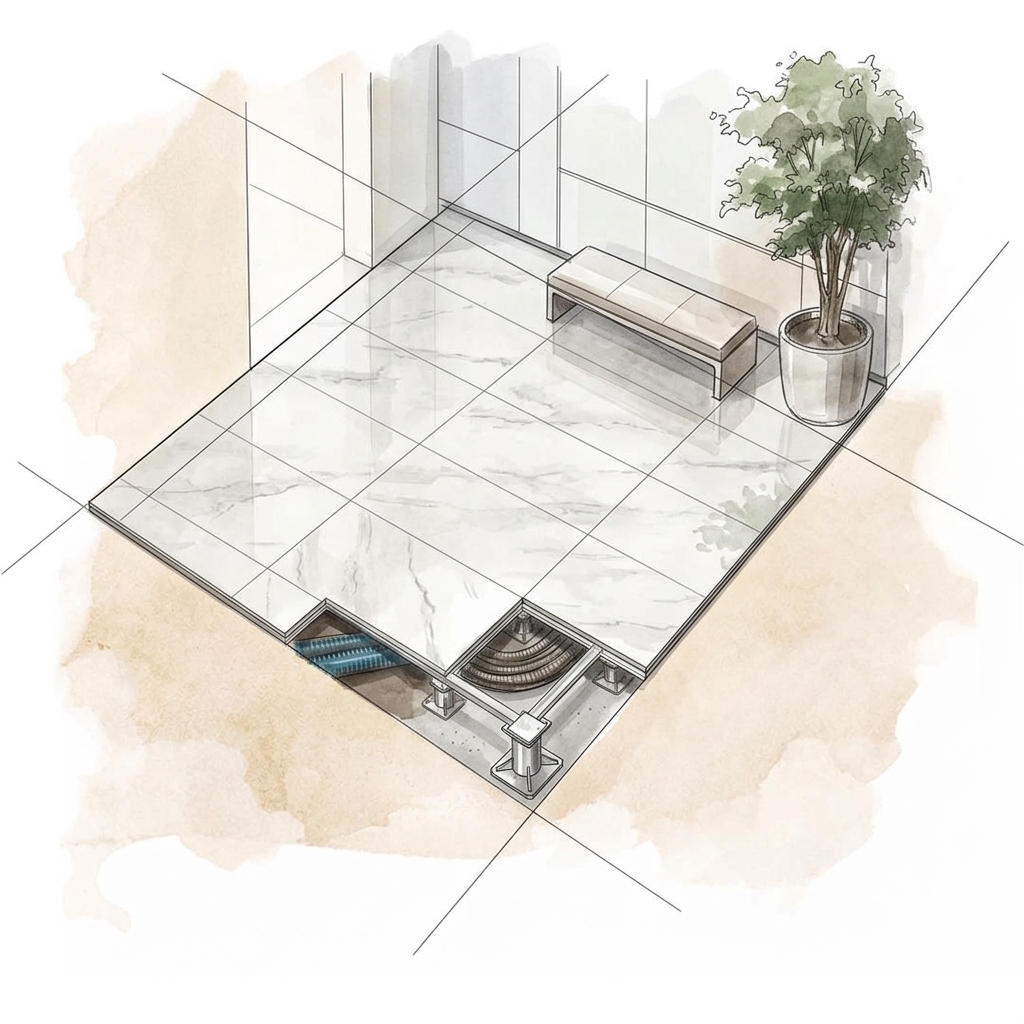
They replicate the warmth and elegance of natural materials—such as wood, stone, and marble—while eliminating the risk of deterioration and the burden of intensive maintenance.


Aesthetics and functionality
The design freedom of porcelain stoneware combined with the technology of low-profile raised flooring. Elegant, turnkey solutions for both interiors and exteriors.
Transform the floor surface into an invisible technical space for housing utility systems, with no compromise to the visual or architectural impact.

Porcelain stoneware finishes offer a high-end, enduring aesthetic that is highly valued by contemporary designers:
They replicate the warmth and elegance of natural materials—such as wood, stone, and marble—while eliminating the risk of deterioration and the burden of intensive maintenance.
Porcelain stoneware does not yellow or fade over time when exposed to direct UV rays, ensuring that the original architectural design remains unchanged.
A wide range of sizes and effects is available to support the creative vision of designers and enhance large-scale architectural spaces.

Eliminating physical and visual barriers between interiors and exteriors is one of the most sought-after architectural trends, perfect for creating spacious, light-filled environments.
Turnkey management: a single point of contact for technical and designer flooring.
Our service goes beyond simple supply. Imola Tecnica acts as your engineering partner, providing support from the initial project conception all the way to the installation of your indoor and outdoor raised flooring. We offer a direct consultative relationship that upholds the architect’s aesthetic vision while providing peace of mind to the client—ensuring cost certainty, awide range of solutions and finishes, flawless attention to detail, and asingle point of contact responsible for the entire project.
Imola BO
Tokyo 105-7444
Bologna BO
Yes, breaking down the aesthetic boundaries of the building envelope is one of the most significant benefits of porcelain stoneware.Outdoor ceramic raised floorsare resistant to rot and freeze-thaw cycles, preserving their primary structure intact. This feature allows architects and designers to extend thefinishes of indoor raised floorsto outdoor spaces such as terraces or rooftops, maintaining a rigorous material and functional alignment.
Absolutely. The versatility of our designer raised floors allows architects to juxtapose different material finishes within the same space, transforming the walking surface into an invisible, accessible technical void. Adopting a raised floor for hybrid spaces effectively meets the demands of contemporary architecture, creating versatile surfaces that simultaneously accommodate and balance ceramic tiles, wood, and carpet.
No, wood-effect porcelain stoneware floating floors guarantee absolute color stability even under direct sunlight. Unlike natural wood, ceramic does not deteriorate, yellow, or undergo aesthetic changes over time. Using porcelain stoneware in outdoor settings offers fundamental engineering guarantees:
Absolutely. Raised stoneware floors for large spaces are ideal for architecturally enhancing entrance halls, open spaces, and large executive offices. The use of oversized formats responds to a specific design choice: by minimizing joints, a single-material flooring with a seamless surface is created , ensuring a decidedly more fluid aesthetic without visual interruptions. Furthermore, these large-format modules can also be installed safely on raised outdoor floors, as they rest on reinforced substructures that optimally distribute weight.
Designers choose floating floors made of stone-effect stoneware—as well as wood-effect or marble-effect versions—to combine the aesthetic warmth of natural materials with the enduring durability of ceramic. Natural materials are prone to porosity, wear, and staining, whereas stoneware eliminates the risk of degradation and significantly reduces the need for maintenance.
Yes, the system based on the IT 2.6 gres-on-gres support is ideal for outdoor flooring exposed to water. Unlike traditional panels that risk irreversible warping in the rain, this system bonds the finishing slab to a porcelain stoneware base, making it completely inert to moisture and ensuring long-term structural stability.
Yes, breaking down the aesthetic boundaries of the building envelope is one of the most significant benefits of porcelain stoneware. Outdoor ceramic raised floors are resistant to rot and freeze-thaw cycles, preserving their primary structure intact. This feature allows architects and designers to extend the finishes of indoor raised floors to outdoor spaces such as terraces or rooftops, maintaining a rigorous material and functional alignment.
Entrust our team of engineers with the study of your specifications and the selection of the optimal support.